Between the Commute and the Kettle: Where Devotion Lives in a British Working Week
There is a particular kind of November light in Britain: grey by half past three, gone by five. For most working households the hours between the commute home and the evening meal are the thinnest of the day — children to be fed, uniforms to be found, emails still arriving. It is precisely here, in that narrow band of time, that many Hindus quietly keep faith alive.
Not with ceremony, necessarily. Not with a priest or a lamp or a full aarti. Often with something far smaller: a mantra repeated under a coat, a prayer said while the kettle comes to the boil, a phone that buzzes at six o’clock with a reminder that the sandhya lamp is due.
This is devotional life as most people actually live it — unglamorous, brief, repeated. And, according to the devotees we spoke to, remarkably durable.
The 7:42 to Waterloo
Anjali, twenty-six, is a trainee solicitor who travels from Woking into London four days a week. Her practice began almost by accident.
“The train is the only place nobody can ask me for anything,” she says. “So I started using ten minutes of it. I don’t close my eyes dramatically or put my beads on the table. I just say the Gayatri quietly, to myself, and watch the fields go past.”
She is careful not to dress it up as self-improvement. “It isn’t a wellness app. It isn’t about being more productive. If anything it makes me less efficient — I arrive having done nothing useful at all. That’s rather the point.”
Her mother, she admits, finds it a little thin. “She grew up with a proper morning routine, full puja, everything timed. But she also worked shifts for twenty years, so she understands that my version is the one that survives contact with my diary.”
‘It Doesn’t Need a Room’
Rajesh, fifty-eight, drives buses in Birmingham. His first duty begins before five many mornings. The house is dark; the family is asleep; there is no question of a lamp or a bath or a bell.
“I put the kettle on and I say my prayer. Twenty seconds. Then I put my shoes on,” he says. “That is my puja. God has never complained about it.”
What has stayed constant, he says, is not the form but the address — the sense that the day is being handed over to something larger before it begins. “You cannot drive a bus full of people and think only of yourself. The prayer makes me remember that before I pull out of the depot.”
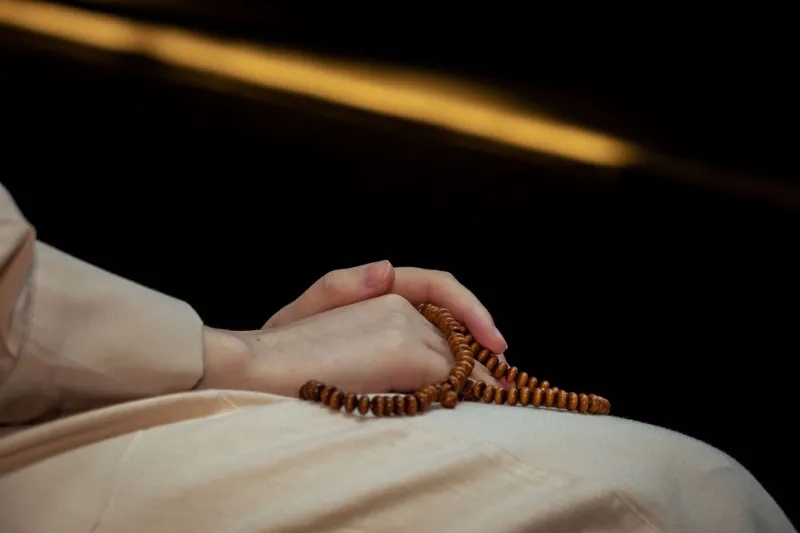
Devotional life, in this telling, is portable. It lives in a coat pocket with a small mala, in a laminated card in a wallet, in a cupboard that opens to reveal a photograph and a matchbox. The tradition has always been skilled at this — the shrine that fits in a suitcase, the mantra that needs no equipment at all.
Three Generations, Three Rhythms
Meera, seventy-one, in Cardiff, keeps the most structured practice of anyone we spoke to — and even hers has been reshaped by family life. Her phone, set by her granddaughter, chimes at six each evening.
“I would forget otherwise. I am honest about that,” she says. “I do my aarti, sometimes only two minutes. When my husband was alive we did it properly, with the conch, the full thing. Now it is shorter. But it is every day, and that is what matters.”
Her granddaughter Nisha, nineteen, a student in Bristol, describes a different rhythm again: no fixed time, but a habit of saying a mantra while walking to lectures rather than listening to a podcast. “It resets me,” she says. “I don’t post about it. I’m not sure my flatmates know I do it. It’s mine.”
Dev, forty-one, teaches at a secondary school in Manchester, and has settled on three slow breaths and a silent mantra before his first lesson. “Not because I’m holy,” he says, laughing. “Because year tens are year tens. It’s the difference between responding and reacting.”
Five Minutes, No Equipment: A Gentle Starter Set
For readers who would like to begin but cannot picture where a practice would fit, here is a modest set — none of it requires a shrine room, a priest, or an empty hour.
- The kettle pause. Before you pour, stand still and repeat your mantra once. The kettle takes as long as it takes; let that be the duration.
- One mala, or eleven breaths. A full 108-bead mala is traditional; a count of eleven breaths is not. Either will do. Consistency matters more than the number.
- A lamp at dusk. One tea light on a windowsill, lit at roughly the same time each evening, does more for the rhythm of a household than an elaborate arrangement attempted once a month.
- The walking mantra. Choose a short phrase and give it the walk between the station and the office, instead of the news.
- A single line at bedtime. One sentence of gratitude, or one line of a prayer you know from childhood. Said, not performed.
When the Week Swallows It Whole
Every devotee we spoke to was clear about one thing: they miss days. Sometimes weeks.
“There was a period after my second child was born when I did nothing for nearly a year,” says Anjali. “I felt guilty about it, and then I stopped feeling guilty, because guilt is not devotion. I started again on an ordinary Tuesday. There was no announcement.”
This, perhaps, is the quiet wisdom in the accounts we heard. A practice is not a scoreboard. The tradition speaks of bhakti as a river rather than a target — something that runs whether or not you are standing at the bank watching it.
For households in Britain juggling shift patterns, school runs and long rail journeys, that may be the most useful thing of all: permission to keep it small, and to begin again tomorrow, and the day after that, without ceremony.