Room for Quiet: How Mauna Is Finding a Home in British Hindu Life

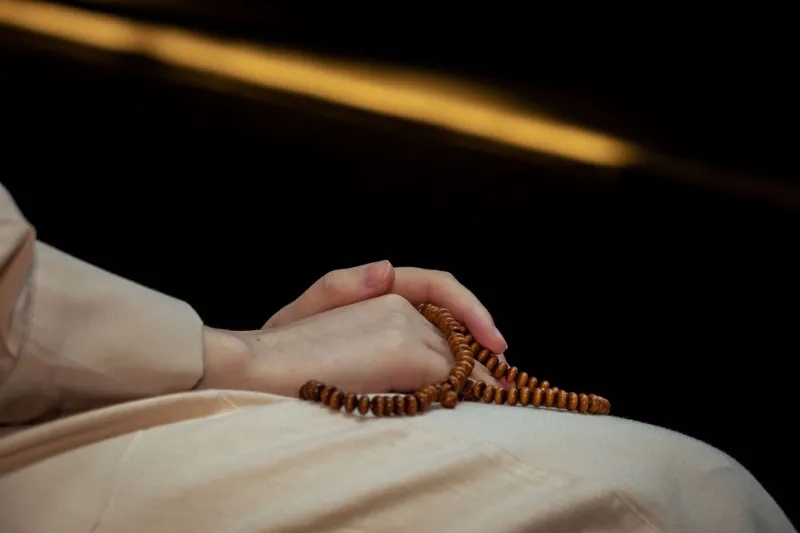
Photo: Rajesh Dhungana, CC BY-SA 4.0, via Wikimedia Commons
There is a particular sound inside a mandir at seven in the morning on a weekday. Somewhere in the building a bell is being rung, a door is being unlocked, and a kettle is coming to the boil — but the dominant note is not a sound at all. It is the space between them. It is a room where nobody is talking, and where the absence is deliberate.
That deliberate absence has a name. Mauna — from the same root as muni, one who observes silence — is the practice of refraining from speech, not as a punishment or an awkwardness, but as an offering. It is old, unglamorous and, by most accounts, difficult. It is also, if conversations around our mandir are any indication, quietly returning to favour.
An Old Practice in New Conditions
Britons of all faiths and none are being told, constantly and in every medium, that they are distracted. The phones, the group chats, the school run, the inbox, the news alerts: this is the standard diagnosis of modern life, and it is not wrong. What the diagnosis rarely offers is a practice rather than a restriction.
Mauna is a practice. It does not require an app, a subscription, a retreat in the countryside or a week off work. It requires a decision, a period of time, and the willingness to sit with the discomfort of not filling it. In a religious context it is not merely a productivity technique. Silence is understood as a condition in which the mind can settle, and in which attention can turn towards the divine rather than towards the next thing.
What the Teachings Say
The classical texts are consistent on the point but not sentimental about it. Silence of the mouth is described as the first and simplest form of mauna, but it is understood to be the outer layer of something harder: silence of the mind, the stilling of the internal commentary that continues long after one has stopped speaking. The Brihadaranyaka Upanishad, in its instruction on the threefold discipline of the offspring of Prajapati — dama, dana and daya, restraint, giving and compassion — places self-restraint first, and speech is where most of us find restraint hardest.
In the devotional traditions, mauna is often associated with tapas, with austerity, and with the practice of sages rather than of household life. This is where a little translation is needed. A householder in Britain is not expected to retreat to a cave. But the principle that speech is a resource to be spent carefully, not a reflex to be indulged, travels remarkably well.
Our own temple teachings return often to the same practical observation: a person who cannot be quiet cannot listen, and a person who cannot listen cannot be taught.
Voices from the Mandir Community
One of our volunteers, who works in a hospital on rotating shifts, describes beginning with ten minutes of silence in the car before entering the building. "Not meditation, exactly," she says. "Just not talking, and not putting the radio on. It turned out that I had been using noise to avoid thinking about the shift ahead of me."
A father of two in our congregation began a different version. He takes the first five minutes of the drive home from work in silence — no phone, no podcast, no calls. What began as a Lenten-style experiment has become a small family rule, and the children now police it with enthusiasm.
And a retired member recalls the opposite of a rule: a period after her husband's death when she found she could not speak in the mandir at all, and worried that she was being disrespectful. "A pujari told me that silence was the older prayer and that I should carry on. I have carried on for nine years now. I still speak at home. But there is a part of the day that is not for words, and I would not give it up."
Silence Is Not Absence
It is worth naming a common misunderstanding. Mauna is not withdrawal from community, and it is not sulking. At the mandir, silence in the prayer hall coexists with chatter in the kitchen, and the two are not rivals. Families arriving with children should know that a temple is not a library; a baby who cries during aarti is not breaking a rule. Mauna is a practice one undertakes, not a condition one imposes on others.
Nor is it an escape from difficult conversation. Several members make the point, unprompted, that they still speak up when something needs saying. The silence being cultivated is a silence around the noise, not around the truth.
Starting Small: Practical Ways to Practise
The tradition is clear that this is a gradual discipline, so these suggestions are deliberately modest.
- Five minutes before the morning lamp. Light your lamp and then say nothing until it has been lit and watched for a few minutes. Let the aarti be the last sound rather than the first of a stream.
- A silent commute. Choose one leg of your journey each day. No headphones, no scrolling. Let the bus be a bus.
- Silence at the threshold. Before entering the house, or the mandir, take three breaths without speaking. It marks a change of state and costs nothing.
- One meal, no commentary. Many households now keep the first few minutes of a meal quiet before conversation begins.
- Set a stopping point. Ten minutes is enough to begin with. Longer stretches are traditionally undertaken with guidance, and there is no prize for endurance.
A Caution or Two
A word of honest counsel. Mauna of the mouth can be practised alone; mauna of the mind rarely is. If the silence produces agitation rather than calm, that is common and worth mentioning to someone — a teacher, a pujari, a friend with a settled practice. The tradition treats this as a discipline to be accompanied.
It is also worth saying plainly that silence should not become isolation. For anyone whose circumstances already involve too much solitude, the practice may lie in the opposite direction: in joining a bhajan group, in volunteering in the mandir kitchen, in speaking. Mauna is a tool for attention, not a rule about being alone.
Closing the Door Gently
At Shree Shakti Mandir, the prayer hall is open at various points through the week, and there is nearly always a quiet corner available to those who arrive outside the busy hours. We do not advertise a silence programme, and we have no certificates to award. We simply note, with some interest, how many of you are quietly sitting down.
If you have never tried mauna, five minutes is enough to begin. Light the lamp, set down the phone, and let the room be a room. The stillness is not empty. It never was.