Between Towpath and Tradition: How a British Mandir Can Host Chhath Puja with Care
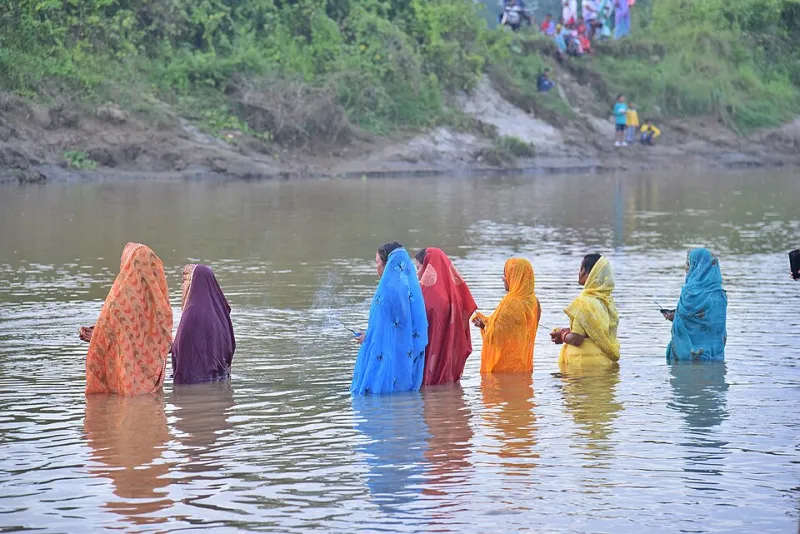
Photo: পাপৰি বৰা, CC BY-SA 4.0, via Wikimedia Commons
There is a particular sound to Chhath Puja in Britain: the low murmur of a family group on a towpath before first light, the rustle of a soopa being lifted, and the soft splash of water against a canal bank that is, for a few hours, the most sacred place in the country. For many devotees the festival is inseparable from standing at the water's edge. Yet in the UK that edge is usually administered by a council, a water company or the Canal & River Trust, and it is often an hour or more from the nearest mandir.
This weekend, as the sixth day of the bright half of Kartik brings the great evening offering and then the dawn offering the following morning, thousands of British Hindu households will make that journey. Shree Shakti Mandir's view is straightforward: a mandir does not need to own a river to serve the people who stand beside it. What families need is preparation, a familiar face in a high-visibility tabard, and the confidence that someone has spoken to the authorities in advance.
A Festival That Lives by Water
Chhath is unusual among the major Hindu observances in Britain in that the mandir building plays a secondary role. The rituals of Nahay Khay, Kharna and the two arghyas are largely domestic and, in their public dimension, deeply tied to open water. The offerings are made to the setting and rising sun, and the traditions carried with them — the soopa of seasonal fruit, the thekua pressed by hand, the songs passed down through the women of a family — belong to the household first and the institution second.
That does not diminish the mandir's duty. It redefines it. Rather than hosting the main ritual, a temple community can act as the steadying infrastructure around it: advising on suitable and lawful locations, coordinating volunteers, ensuring older devotees can reach the water safely, and holding the institutional memory so that next year is easier than this one.
Voices from the Bank
"We leave Leicester at four in the morning," says Sunita, who has observed Chhath in Britain for nineteen years. "The spot we use is off a lane with no lighting. We take torches, we take flasks, and we watch the older ones on the grass because the bank is uneven. What would help is knowing the council has been told we are coming, and that someone has checked the ground in the week before."
Others speak of the practical brokerage a mandir can offer. "Our first year here, we did not know who to ask about parking near the reservoir," says Rajesh, who now travels with three generations of his family from outer London. "Now the mandir seva team rings the council in October. It is a small thing. It changes the whole morning."
There is also the matter of continuity. "My mother sang the Chhath geet and I sing them badly," one devotee from Wolverhampton admits with a smile. "But my daughter learns a line more each year. That is how it survives here. Not in a book. In a car at five in the morning."
Working With Councils and the Canal & River Trust
Where a gathering is expected to be sizeable, early contact is essential. The Canal & River Trust manages the great majority of Britain's navigable waterways and publishes guidance on event organisers' responsibilities on its towpaths and offside banks. Councils, meanwhile, hold the relevant permissions for parks, reservoirs and foreshores, and can advise on parking, temporary signage and waste collection.
A good approach, refined by several mandirs over recent years, runs roughly as follows:
- Begin conversations in September or early October, not the week before.
- Identify a single named contact within the mandir who will liaise throughout.
- Confirm whether the site permits gathering, and whether any formal permission or insurance certificate is required.
- Ask about vehicle access, drop-off points for elderly devotees, and lighting.
- Agree a plan for waste: offerings should not be left in the water or on the bank. Flowers and fruit should either be taken home or collected by volunteers for respectful disposal.
- Confirm that no one will enter the water. This is a point on which organisers should be unambiguous with their own communities.
Cold Water, Dark Evenings and the Marshal Model
A British November is not a northern Indian one. Water temperatures in canals and rivers remain dangerously low, cold water shock is a genuine hazard, and dusk falls before five o'clock. The evening arghya in particular takes place in darkness or near-darkness.
Shree Shakti Mandir recommends a simple volunteer marshal structure that any community can adopt:
- A minimum of four marshals per gathering, briefed in advance and identifiable by high-visibility tabards.
- Two marshals stationed at the water's edge, whose sole responsibility is to keep devotees — particularly children — a safe distance back.
- One marshal at the entrance or drop-off point, guiding vehicles and assisting those with mobility needs.
- One marshal free-roaming, carrying a first-aid kit, a torch and a charged mobile phone with the postcode of the location written down.
- Battery lanterns rather than open flames on the bank, and a supply of blankets and a flask of hot water for anyone who becomes chilled.
- A short briefing before the ritual begins, delivered in the community's own language, restating that no one goes into the water.
A written risk assessment, however modest, is worth preparing. It is increasingly requested by landowners and it concentrates the mind usefully.
Carrying the Soopa Across Generations
The soopa — the woven bamboo tray of fruit, thekua and sugarcane — is where the festival's transmission happens most visibly. In Britain, ingredients shift with availability: British apples in place of certain Indian fruits, sugarcane sourced from specialist grocers, thekua made in batches in home kitchens the week before. Mandirs can support this without interfering in it, by sharing supplier information through the noticeboard, hosting a thekua-making afternoon in the temple kitchen, and inviting grandmothers to teach the Chhath geet to younger women and girls in the weeks beforehand.
It is also worth recording. A short audio archive of the songs, made with consent and kept by the mandir, is a modest act of preservation that families often later treasure.
A Checklist Any Mandir Can Adapt
- Confirm the date according to the Kartik lunar calendar and circulate it early.
- Identify the water site and check its status with the relevant authority.
- Appoint a lead coordinator and a marshal team.
- Conduct a site visit a fortnight beforehand, in daylight and after dark.
- Arrange drop-off access for older and disabled devotees.
- Prepare a risk assessment and a one-page safety briefing.
- Agree a waste and offerings plan.
- Publicise the plan through the noticeboard, WhatsApp groups and the temple's community voices channel.
- Debrief afterwards, in writing, so that next year begins where this one ended.
Looking Towards Next November
Chhath will return, as it always does, with the sun and the water and the sound of a family singing quietly on a cold British bank. The mandir's task is not to bring the river indoors, but to make sure that the people who go to it are expected, prepared for and safe. That is seva in its plainest and most useful form, and it is well within the reach of any community willing to plan a little earlier than the festival itself demands.
Anyone wishing to join Shree Shakti Mandir's Chhath coordination team for next November, or to share experience of a particular water site, is invited to speak to a member of the seva team after any evening aarti.